
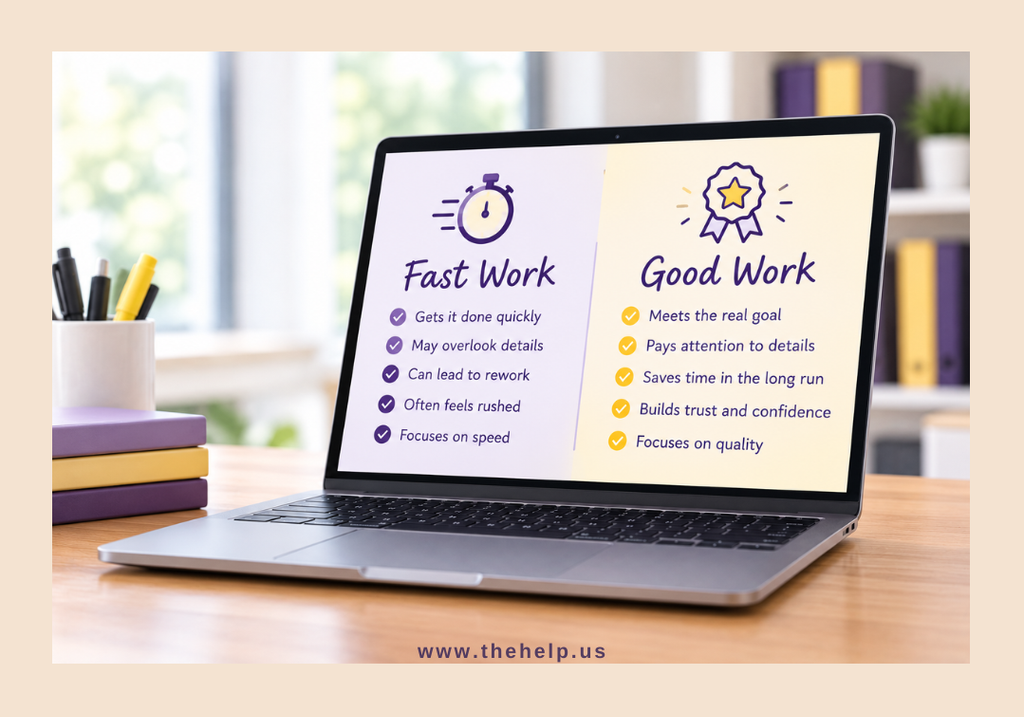
In business, speed is often celebrated.
Answer the email quickly.
Finish the report quickly.
Return the customer’s call quickly.
Complete the task quickly.
And while being efficient is important, there’s a problem with focusing too much on speed:
Fast work isn’t always good work.
A task completed in 10 minutes may seem more productive than one that takes 30 minutes. But what happens if the 10-minute version contains mistakes, missing information, or has to be redone later?
Suddenly, those 20 minutes you saved don’t look like much of a saving.
Good businesses don’t simply ask, “How quickly can we get this done?”
They also ask:
“Was it done correctly?”
Fast Work Can Create More Work
Imagine an employee rushes through a spreadsheet and accidentally enters several incorrect numbers.
The task is technically finished.
But someone now has to find the errors, correct them, verify the information, and potentially explain why the mistake happened.
The original task may have taken 20 minutes.
Fixing the problem could take an hour.
This is one of the hidden costs of prioritizing speed over quality.
The same thing can happen with:
- Customer emails
- Data entry
- Bookkeeping
- Research
- Reports
- Scheduling
- Document preparation
- CRM updates
- Administrative tasks
Finishing something quickly doesn’t necessarily mean you’ve saved time.
Sometimes you’ve simply moved the work further down the line.
Good Work Is More Than Being Accurate
Accuracy is important, but good work involves more than avoiding mistakes.
Good work is:
Accurate.
The information is correct and complete.
Consistent.
The task is performed according to an established process.
Thorough.
Important details aren’t overlooked.
Timely.
The work is completed when it’s needed.
Useful.
The finished product actually serves its intended purpose.
That’s what effective Business Support Services should provide—not simply more completed tasks, but reliable results.
Speed Still Matters
This doesn’t mean businesses should take all day to complete every task.
Speed absolutely matters.
Customers expect timely responses. Deadlines matter. Teams depend on one another. Delayed work can hold up an entire operation.
The goal isn’t to choose between speed and quality.
The goal is to find the right balance.
Think of it this way:
Fast + inaccurate = more work
Slow + accurate = potentially inefficient
Fast + accurate = effective
The ideal is not simply to work faster.
It’s to develop processes that allow people to work efficiently without sacrificing quality.
Why Processes Matter
If employees are constantly being told to “work faster,” they may naturally begin cutting corners.
But if the process itself is inefficient, working faster won’t solve the underlying problem.
For example, imagine an employee has to:
- Find information in one system.
- Copy it into a spreadsheet.
- Re-enter the same information into another system.
- Email the spreadsheet to another employee.
- Wait for approval.
- Make another update.
- Create a report.
You could tell that employee to work faster.
Or you could look at the workflow and ask:
Why are we doing all of these steps?
This is where Business Process Improvement becomes important.
Instead of asking people to work harder, businesses can examine the process itself and identify opportunities to eliminate duplication, simplify steps, improve communication, and use technology more effectively.
Workflow Optimization Can Improve Both Speed and Quality
A well-designed workflow doesn’t force you to choose between doing something quickly and doing it correctly.
It can help you achieve both.
Workflow Optimization may involve:
- Eliminating unnecessary steps
- Creating standardized procedures
- Automating repetitive tasks
- Improving communication between team members
- Organizing information more effectively
- Establishing quality-control checks
- Assigning tasks to the right person
- Using technology where it makes sense
When the process is clear, employees spend less time figuring out how to do the work and more time actually doing it.
The Importance of Attention to Detail
Some tasks simply cannot be rushed.
Consider bookkeeping.
A small error in a financial record may seem insignificant at first, but it can create problems later.
That’s why Bookkeeping Support requires more than simply entering numbers quickly.
The same is true for customer information, contracts, reports, CRM records, and other business documents.
Attention to detail isn’t about being slow.
It’s about recognizing which details matter.
A good support professional knows when a task requires speed and when it requires an extra review.
Customer Service Is a Great Example
Customer service is another area where speed and quality need to work together.
Customers appreciate fast responses.
But a fast response that doesn’t answer their question can be frustrating.
Imagine sending a customer a response within five minutes—only to have them email again because their actual problem wasn’t addressed.
That’s not necessarily great service.
Customer Experience Support should focus on both responsiveness and resolution.
The goal is not simply:
“How quickly did we respond?”
It’s also:
“Did we actually help?”
Technology Can Help—If It’s Used Correctly
Technology and artificial intelligence can help businesses improve both speed and consistency.
AI can assist with research, summaries, drafting, data organization, and repetitive tasks.
Automation can reduce manual work and eliminate unnecessary steps.
But technology doesn’t remove the need for quality control.
AI Business Support works best when technology is combined with human oversight.
For example, AI might create a first draft or organize information quickly, while a person reviews the result for accuracy, context, tone, and completeness.
The objective isn’t to make humans work faster at all costs.
It’s to help them spend less time on repetitive work and more time on work that requires human judgment.
The Right Person for the Right Task
Another way to improve both speed and quality is to make sure tasks are assigned appropriately.
A business owner may be capable of managing their inbox, updating a spreadsheet, scheduling meetings, and preparing reports.
But that doesn’t mean they should personally handle all of those tasks.
With Administrative Support, Executive Support, or Remote Administrative Support, routine responsibilities can be handled by trained professionals while business owners focus on higher-value responsibilities.
This is one of the benefits of Virtual Assistant Services.
Delegation isn’t about giving work to someone simply because you don’t want to do it.
It’s about assigning work to the person best positioned to complete it effectively.
Measure the Result, Not Just the Speed
One of the easiest ways to improve your team’s approach to productivity is to stop measuring success by speed alone.
Instead of asking:
“How many tasks did we complete?”
also ask:
- How many errors occurred?
- How much work had to be redone?
- Were deadlines met?
- Did customers receive the right information?
- Was the process followed?
- Did the work achieve the desired result?
- Did the task create additional work for someone else?
These questions provide a much clearer picture of productivity.
Because completing 100 tasks isn’t particularly impressive if 30 of them need to be corrected later.
Good Work Creates Trust
Clients and customers may not know how long you spent completing a task.
But they notice the result.
They notice when information is accurate.
They notice when emails are clear.
They notice when follow-ups happen when promised.
They notice when documents are organized.
They notice when someone catches a problem before it becomes their problem.
Quality builds trust.
And trust is one of the most valuable things a business can build.
Fast Doesn’t Have to Mean Careless
The good news is that speed and quality don’t have to be opposites.
With the right systems, training, technology, and Business Operations Support, teams can become both faster and better.
The key is to improve the way the work gets done—not simply pressure people to complete it faster.
Ask:
Can we simplify the process?
Can we eliminate unnecessary steps?
Can we automate part of the work?
Can we create a checklist or standard procedure?
Can someone with the right skills handle this task?
Can we build a quality check into the workflow?
These questions can lead to sustainable improvements instead of temporary increases in speed.
The Goal Isn’t to Work Faster
It’s tempting to think that productivity means getting more things done in less time.
But true productivity is about creating meaningful results with the time and resources available.
Sometimes that means working quickly.
Sometimes it means slowing down long enough to check the details.
Sometimes it means delegating the task.
Sometimes it means improving the process.
And sometimes it means using technology to eliminate the task altogether.
At The Help, we believe effective Remote Business Support is about more than simply getting things off your to-do list. It’s about providing dependable support that helps businesses operate efficiently while maintaining the quality their customers expect.
Whether it’s Administrative Support, Executive Support, Bookkeeping Support, Customer Experience Support, Business Process Improvement, or AI Business Support, the goal remains the same:
Do the work efficiently. Do it accurately. And do it well.
Because the fastest way to finish a task isn’t always the best way to finish it.
Good work gets the job done. Great work gets it done right.